Overview
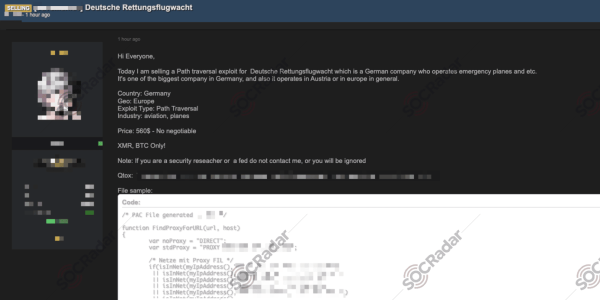
Dark web monitoring on 26 September 2025 uncovered an advertisement offering a path traversal exploit allegedly targeting Deutsche Rettungsflugwacht (DRF), also known as the German Air Rescue Service. DRF is a critical component of Germany’s emergency medical aviation network, providing 24/7 air ambulance operations across Europe.
The seller claimed that the exploit could be used against an online system operated by DRF, allowing access to files and directories beyond intended limits. The exploit was priced at approximately $560, payable in Monero (XMR) or Bitcoin (BTC) – a relatively low amount suggesting the seller’s primary intent is profit through mass sale rather than targeted extortion.
Given DRF’s vital role in emergency response and medical evacuations, any compromise could have severe consequences for operational continuity and public safety.
What Happened?
The dark web post describes the sale of an active path traversal exploit, a web application vulnerability that enables attackers to navigate through restricted directories and access sensitive files stored on a target server. The listing explicitly mentioned that the exploit applies to a German company in the aviation sector, with “DRF” named directly in the title.
The seller provided minimal technical details but emphasized that:
- The vulnerability was tested and functional against DRF’s public-facing systems.
- The exploit could retrieve configuration files, credentials, or other sensitive data from vulnerable servers.
- Payment was required in cryptocurrency, with a quick-delivery offer for buyers.
Path traversal exploits, while often simple to execute, can yield high-impact results if they expose authentication keys, configuration files, or system logs. If attackers gain access to operational or patient-related data, the incident could escalate into data theft, ransomware deployment, or denial of service.
The post’s timing and low price suggest that the exploit could soon circulate more broadly within criminal communities, increasing the likelihood of automated scanning and opportunistic attacks against DRF’s digital infrastructure.
Why This Matters for Aviation
The case raises several important concerns specific to emergency aviation cybersecurity:
- Critical Infrastructure Exposure: DRF operates life-saving air ambulance missions. Disruption of its scheduling, dispatch, or communication systems – even briefly – could have direct life-safety implications.
- Web Application Vulnerabilities: Many aviation operators rely on web portals for logistics, maintenance, or mission coordination. A single unpatched vulnerability can serve as an entry point for deeper compromise.
- Financially Motivated Actors: The relatively modest asking price indicates a commercially motivated seller, not necessarily a nation-state actor. However, once sold, such exploits can quickly spread, multiplying risk.
- Regulatory and Trust Implications: A confirmed exploit or data breach involving DRF could trigger investigations under EU NIS2 and GDPR, while damaging public confidence in the reliability of emergency aviation services.
- Sector-Wide Signal: The listing demonstrates that even medical and humanitarian aviation entities are not exempt from targeted cyber threats, highlighting the need for the same level of cyber vigilance applied to commercial carriers.
Recommended Actions
1. Immediate Vulnerability Scanning
Conduct targeted scans of all DRF web applications, APIs, and internet-facing systems to detect potential path traversal vulnerabilities. Prioritize any servers hosting public or administrative portals.
2. Patch and Harden
If a vulnerability is identified, apply vendor patches immediately or implement temporary mitigations, such as sanitizing user input and validating file paths. Ensure servers are updated and not running outdated frameworks or content-management systems.
3. Deploy Web Application Firewall (WAF)
Enable and fine-tune a WAF to block requests attempting to exploit directory traversal patterns (e.g., “../”). A properly configured WAF can provide effective first-line defense while patches are applied.
4. Review Access Controls
Limit user permissions to the principle of least privilege. Critical operational and medical data should be segregated from public-facing systems. Regularly audit account privileges and disable unused or default credentials.
5. Incident Response Preparedness
Update DRF’s incident response plan to explicitly cover web application exploits and coordinate with CERT-Bund or national CSIRT channels. Define clear escalation and containment procedures for any exploitation attempt.
6. Monitoring and Threat Intelligence
Establish ongoing dark web monitoring for DRF mentions or exploit resale. This helps detect when threat actors attempt to weaponize or resell the vulnerability to other buyers.
In Summary
The alleged sale of a path traversal exploit targeting Deutsche Rettungsflugwacht illustrates how cybercriminals view even humanitarian and emergency aviation providers as profitable targets. Although priced modestly, such exploits can have catastrophic consequences if used to compromise mission-critical systems or sensitive patient data.For organizations like DRF, proactive vulnerability management, web application security, and access control discipline are essential. Cyber resilience in aviation must extend beyond commercial operations to encompass emergency and public-service aviation, where downtime is measured not in profit loss but in human lives.